
Parking Barrier Project Planning in Saudi Arabia
Release time:
2026-10-28
A successful parking barrier project starts long before the boom arm is installed. The project team needs to understand the site layout, traffic patterns, access policy, safety requirements, environmental conditions and the systems that must exchange data. In Saudi Arabia, these decisions are particularly important for exposed car parks, residential compounds, commercial centres, office buildings, industrial facilities and logistics yards where heat, dust, peak-hour traffic and visitor access can affect day-to-day operation. BAROXON's Saudi-market range includes automatic boom barrier gates, high-speed barriers, ALPR/LPR number-plate systems, RFID barriers, radar sensors and related access-control equipment that can be specified as part of a coordinated solution.
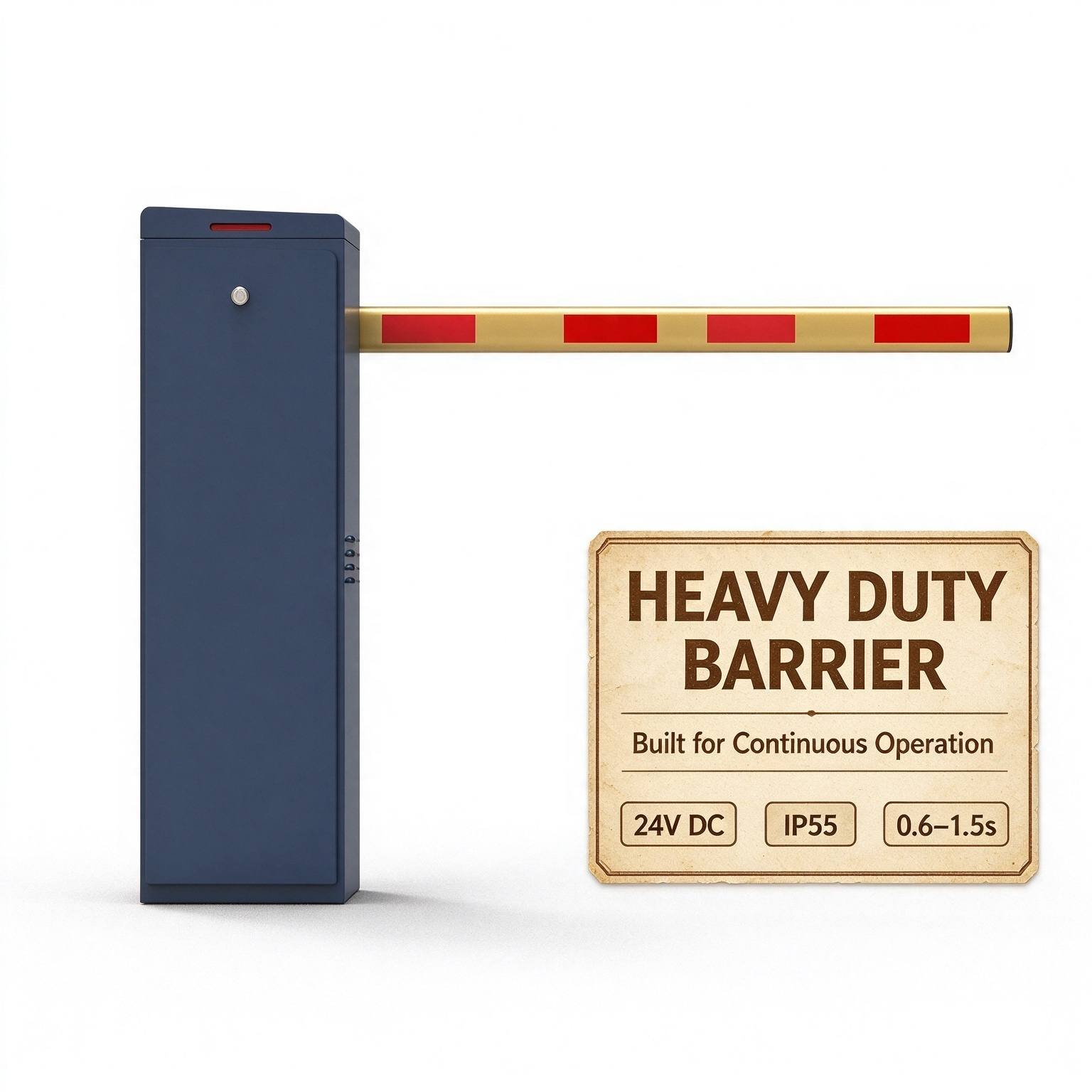
1. Define the Project Brief Before Selecting Equipment
Begin with a written project brief. Identify the site type, number of entrances and exits, number of lanes, operating hours, expected vehicle movements per hour, vehicle classes and whether access is controlled by residents, employees, visitors, tenants, deliveries or the public. Also record whether the site needs ticketless parking, payment at the exit, visitor pre-registration, remote monitoring, a manual attendant option or integration with an existing building-management or parking platform.
Set measurable acceptance goals at this stage. Examples include maximum queue length at peak time, acceptable vehicle processing time, availability expectations, how exceptions are handled and which records operators must be able to retrieve. Avoid specifying a barrier only by its opening speed or purchase price: a complete lane includes the barrier, access-identification method, safety devices, control logic, power and network provision, installation and ongoing support.
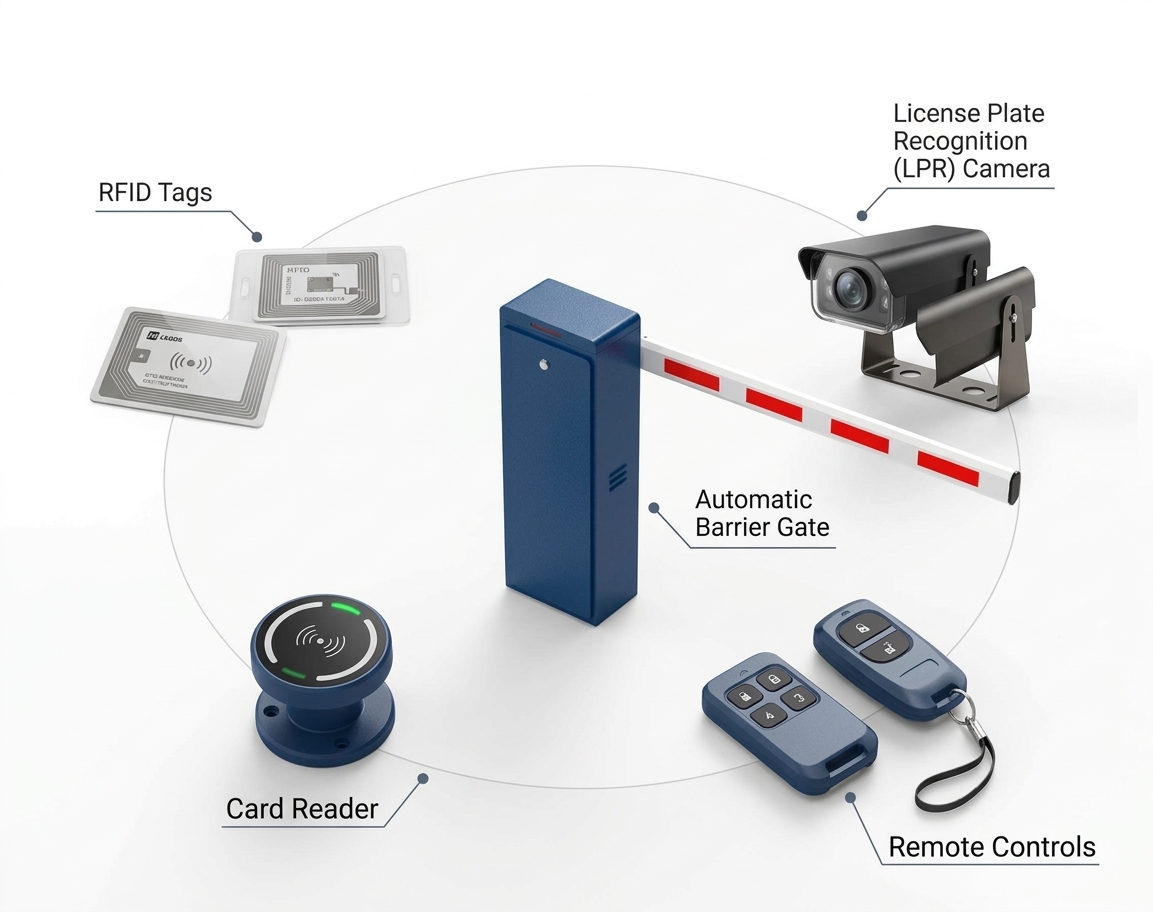
2. Conduct a Detailed Site Survey
A site survey should be completed before the final equipment schedule is approved. Measure the clear lane width, kerb positions, island dimensions, available mounting space, overhead clearance, approach angle and the distance between the stopping point and the barrier arm. Record the location of guard booths, pedestrian walkways, accessible routes, emergency access, drainage channels, lighting, existing cabinets and nearby utilities. Photograph each approach and exit from the driver's viewpoint as well as from the proposed equipment positions.
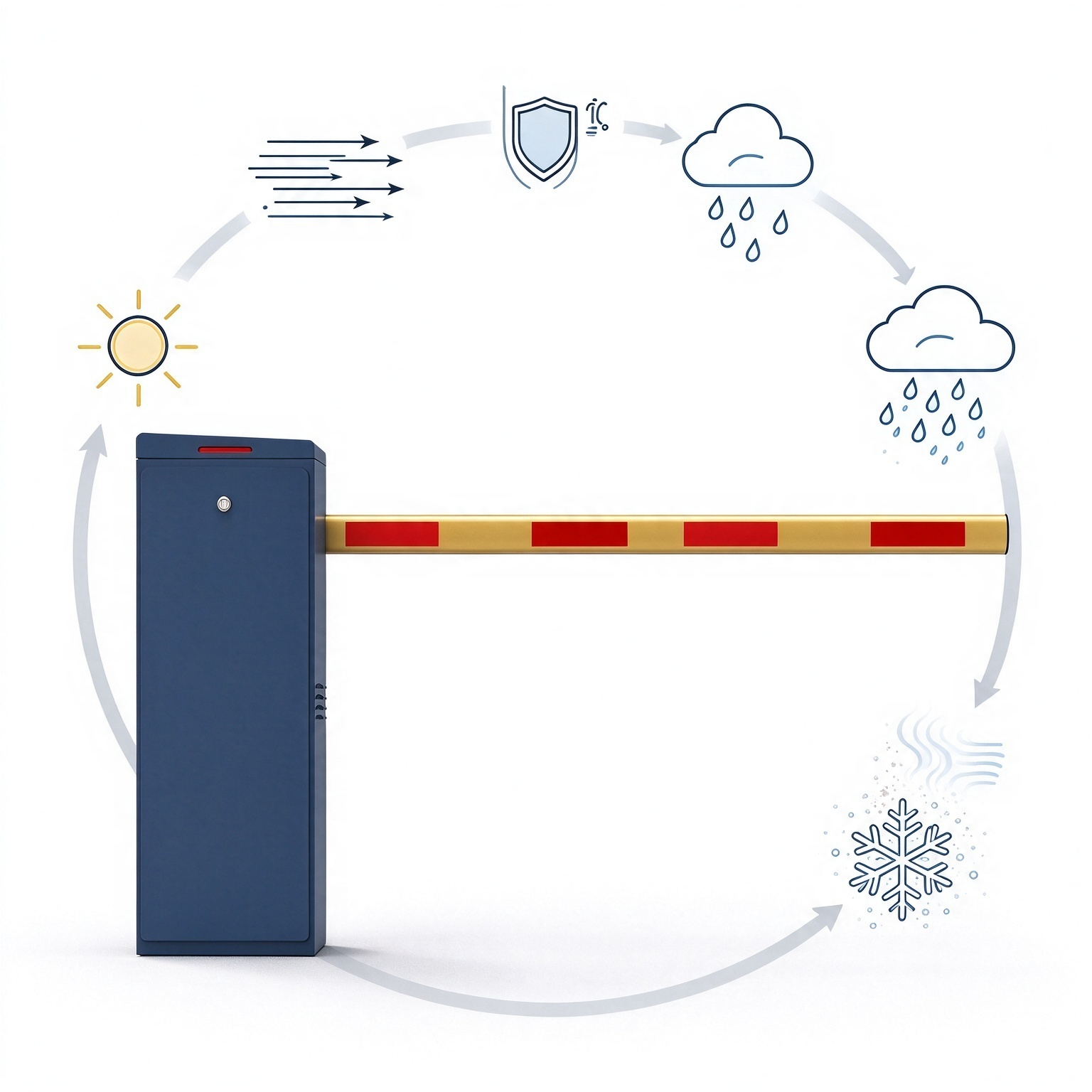
Check the surface and foundations. The barrier cabinet needs a stable, level mounting base, while conduits and cable routes should be planned so that they do not create trip hazards or interfere with drainage. Confirm how rainwater is managed, whether the area is exposed to dust or blowing sand, whether coastal corrosion is a concern and whether direct sunlight or vehicle headlights may affect a camera. For Saudi sites, confirm the equipment's specified operating-temperature and ingress-protection ratings against the actual location; do not assume every product variant has identical environmental limits.
3. Map Vehicle Flow and Lane Geometry
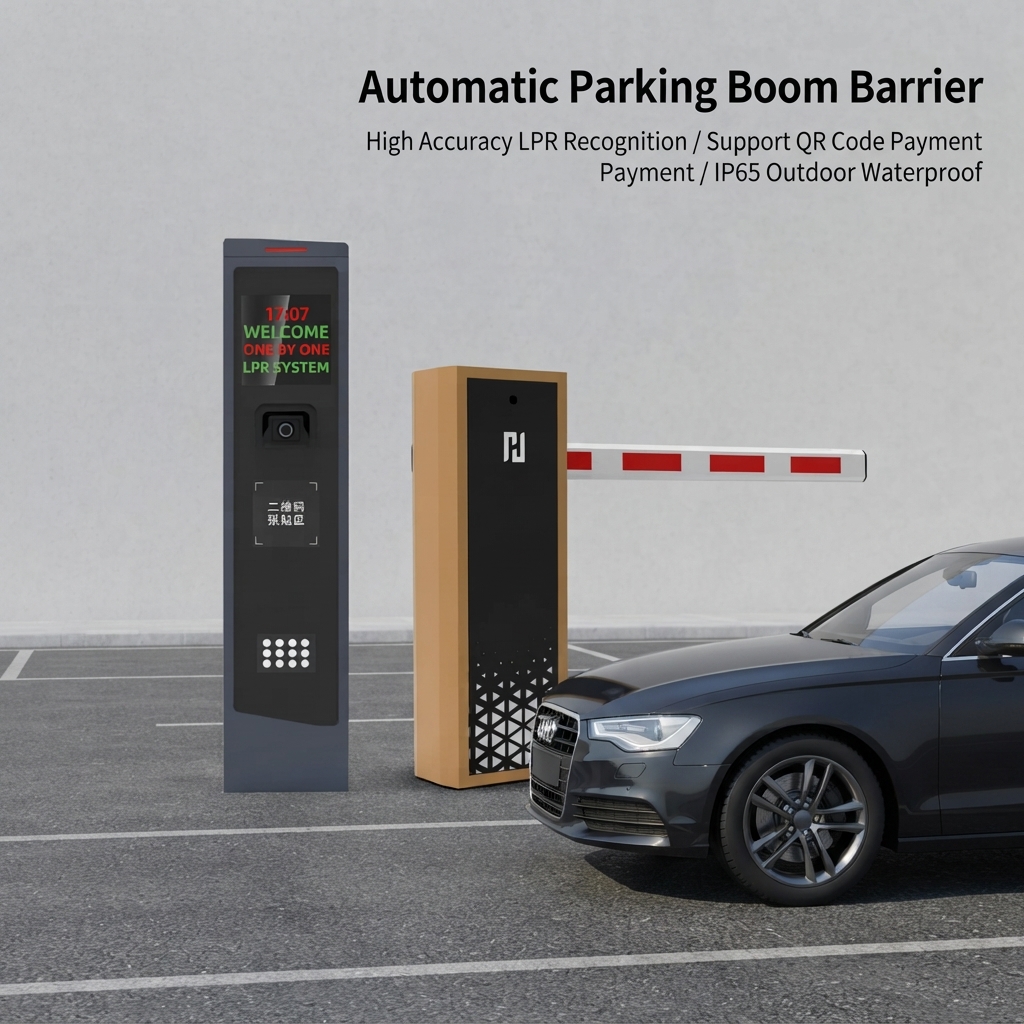
Draw a lane layout showing the approach, stopping line, barrier cabinet, arm swing area, vehicle detector, camera or RFID reader, intercom and any payment or ticketing terminal. Keep enough room for vehicles to stop without blocking a public road or a pedestrian crossing. For wide entrances, evaluate whether separate entry and exit lanes, a central island or multiple controlled lanes would reduce conflict and queueing. Check turning paths for delivery vans, buses, emergency vehicles and heavy goods vehicles if they use the site.
Choose the arm type and length only after the lane geometry is understood. A straight arm may suit a conventional open-air car park; a folding arm can help where overhead clearance is limited, such as some multi-storey car parks; and a fence-style arm may be considered where the access policy calls for a more substantial visual barrier. The selected length, drive and operating speed must match the specific model, wind exposure, traffic frequency and safety design. Never assume that a longer arm can be fitted to any barrier cabinet.
4. Select the Right Barrier and Access-Identification Method
Select equipment around the operational requirement rather than starting with a model number. BAROXON's product categories include standard and high-speed boom barriers, automatic RFID boom barriers, ALPR/LPR camera systems, radar sensors and other access-control equipment. For regular resident or employee vehicles, RFID may be suitable where credentials can be issued and managed reliably. For visitor-friendly or ticketless parking, ANPR/LPR may allow authorisation to be based on the registration plate. Some sites may benefit from a combined approach, with a manual attendant workflow for exceptions.
Match the barrier's duty cycle and opening time to measured traffic demand. A high-traffic commercial entrance may need a drive designed for frequent cycling, while a low-volume private entrance may have different priorities. Verify the exact model's arm-length limits, motor type, opening and closing time, cycle rating, control inputs, emergency release and environmental rating in the current datasheet. Product-family specifications are not a substitute for checking the precise configuration being quoted.
5. Design Safety into the Lane
Safety should be included in the design from the beginning, not added after the barrier is installed. Identify vehicle-presence detection, safety loops or radar sensors, photocells where appropriate, anti-crush or auto-reverse functions where provided, warning lights, arm visibility and emergency-release arrangements. The exact combination depends on the barrier model, lane geometry, traffic mix and applicable project requirements.
Define what happens when a vehicle is detected under the arm, when a sensor is disconnected, when the power supply fails or when the access-control network is unavailable. The system should not treat a failed camera read or a lost network connection as automatic authorisation. Provide a controlled manual override process, train the operators and test emergency access arrangements with the site owner before handover.
6. Plan Power, Network and Civil Works
The site survey should identify the required power supply, isolators, protective devices, earthing, cable routes, network points and any cabinet or communications-room requirements. Separate power and data routes where the project design calls for it, label both ends of every cable and keep maintenance access clear. Confirm whether the site needs wired Ethernet, a local controller, a server or cloud connection, and how the system will behave if the internet connection is lost.
Coordinate civil works with the installer before concrete bases are poured or surfaces are finished. Confirm anchor-bolt positions, conduit entry points, drainage, island dimensions and the final cabinet orientation. Late changes to the island or cable route can delay installation, reduce camera visibility or force an unsafe stopping position. The installation drawing should be approved by the relevant project stakeholders before work begins.
7. Integrate ANPR, RFID, Payment and Existing Systems
Create an integration schedule listing every system, interface, data item and responsible party. A typical lane may link the barrier controller to an ANPR/LPR camera, RFID reader, vehicle detector, parking-management software, visitor registration, payment terminal, intercom or central security platform. Confirm whether the interface uses relay or dry-contact inputs, Wiegand, RS-485, TCP/IP, an API or another supported protocol. Do not assume that two products will interoperate simply because both are described as "smart" or "compatible".
Document the end-to-end sequence. For example: a vehicle approaches; the camera reads the plate or the reader detects a credential; the software checks permissions, booking or payment status; the controller verifies that the lane is safe; the barrier receives an authorised open command; and the event is recorded. Specify time-outs, duplicate reads, mismatched plates and tags, visitor exceptions, offline behaviour and the process for recovering from a failed transaction.
8. Test the Complete System Before Handover
Factory checks and installation checks should be followed by an integrated site acceptance test. Test authorised and unauthorised vehicles, visitor registration, expired or revoked credentials, unreadable plates, duplicate reads, payment failures if applicable, network interruption, power recovery, manual release and emergency access. Run tests at realistic traffic periods and with the vehicle types expected at the site, rather than relying on a single demonstration vehicle.
Record each test result, the expected behaviour, the observed behaviour, any defect and the corrective action. Measure queueing and processing time where those are project targets. Confirm that the event logs show the correct time, lane, vehicle or credential reference and decision outcome. The handover package should include approved drawings, final equipment list, wiring and network diagrams, configuration backup where available, operating instructions, maintenance schedule, warranty information and operator training records.
9. Plan Maintenance and Operational Ownership
Agree who owns day-to-day operation, credential administration, incident review, software updates and maintenance requests. Establish inspection intervals for the arm, cabinet, fixings, moving parts, sensors, loops, warning lights and cables in accordance with the manufacturer's instructions. In hot and dusty locations, include checks for dust build-up, enclosure condition, drainage and the effects of site conditions on cameras and detection equipment.
Keep a record of faults, interventions, replacement parts and changes to access rules. Define escalation routes for a barrier that will not open, a barrier that will not close, a faulty sensor or a failed integration. Confirm the availability of spare parts, technical support, training and the response process agreed with the supplier before the site goes live.
10. Common Project Risks and How to Avoid Them
Common causes of delay include incomplete site measurements, choosing an arm before checking overhead clearance, missing cable routes, unclear ownership of software interfaces, insufficient safety testing and late changes to visitor or payment rules. Reduce these risks by holding a design review with the owner, installer, civil contractor, IT team and parking operator before procurement. Keep a decision log and make sure changes to the lane layout or system logic are reflected in the latest drawings and test plan.
A second risk is overpromising performance. Recognition rates, read distances, opening times, duty cycles and ingress-protection ratings depend on the selected equipment and installation conditions. Ask for the datasheet and interface documentation for the exact quoted configuration, and agree how performance will be verified during acceptance testing. Avoid using headline figures from a product family as guaranteed results for every lane.
Frequently Asked Questions
How early should a site survey be completed?
Complete the survey before finalising the equipment schedule, civil drawings and procurement. Early measurements help identify lane constraints, power and network requirements, camera sightlines, safety zones and mounting needs before they become expensive changes.
Should I choose ANPR or RFID for a parking barrier project?
RFID can suit frequent users with managed credentials, while ANPR/LPR can support plate-based access and visitor workflows. The best choice depends on vehicle types, traffic patterns, access policy, software compatibility, operating costs and how exceptions will be handled. A combined system may be appropriate where different user groups need different access methods.
What information should be included in a barrier project quotation?
Ask for the barrier model and arm specification, reader or camera, safety devices, controller, software licences, interfaces, cabling and civil-work scope, installation and commissioning, training, warranty, spare parts and technical support. The quotation should clearly distinguish included equipment from optional items.
What should be tested before the system goes live?
Test access permissions, vehicle detection, barrier movement, safety functions, visitor handling, ANPR or RFID performance, payment or booking workflows where applicable, network and power recovery, manual release, event logs and operator procedures. Record results and close defects before handover.
Can a parking barrier integrate with an existing access-control platform?
It may be possible if the barrier controller, reader or camera and platform support compatible interfaces and the required events can be exchanged. Confirm the interface specifications and responsibilities with the system integrator before procurement, then verify the complete workflow during acceptance testing.
Conclusion: Treat the Barrier as Part of a Complete Access System
A well-planned parking barrier project follows a clear sequence: define the operating brief, survey the site, map vehicle flow, select the barrier and identification method, design safety and infrastructure, document system interfaces, test the complete lane and hand over the system with training and maintenance arrangements. For projects in Saudi Arabia, verify environmental suitability and actual site conditions rather than relying on generic product claims.
Explore BAROXON's boom barrier and boom gate range, ALPR/LPR parking products and Saudi-market vehicle access solutions when preparing a project specification.
Latest News
Underground Car Park Barrier Guide, Saudi Arabia
Choose an underground car park barrier in Saudi Arabia: clearance, folding-arm geometry, traffic duty, safety sensors, access control and maintenance.
2026-10-28
Straight Arm vs. Folding Arm Boom Barrier: Which Is Better?
Straight arm or folding arm boom barrier? Compare overhead clearance, lane width, traffic volume and Saudi site conditions before you specify a barrier arm.
2026-10-28
Questions to Ask a Parking Barrier Supplier
Thirteen questions to ask a parking barrier supplier in Saudi Arabia: model specs, safety devices, ANPR/RFID integration, climate rating, warranty and total cost.
2026-10-28
RFID vs ANPR Parking Systems for Saudi Sites
Compare RFID and ANPR parking systems for Saudi Arabia: how tags and number plate recognition work, cost, security, traffic flow and when to combine both.
2026-10-28
Parking Barrier Project Planning in Saudi Arabia
Plan a parking barrier project in Saudi Arabia, from site survey and lane design to barrier selection, ANPR/RFID integration, safety testing and handover.
2026-10-28
How to Compare Parking Barrier Manufacturers and Suppliers
Compare parking barrier manufacturers and suppliers on specifications, safety, Saudi climate suitability, integration, warranty, spare parts and total cost.
2026-10-28
Baroxon® | Leading Boom Barrier Manufacturer
Advanced Security Access Control and Intelligent Parking Solutions.
Company Strength
Adequate Inventory
Fast Shipping
Our Products
CONTACT US
Address: No. 2 Wanshou Road, International Innovation Industrial Park, Jinan, Shandong, China






© COPYRIGHT 2025 Baroxon® | Leading Boom Barrier Manufacturer

Contact Us
Our passion is to bring your ideas to life. Work with our design team to create a one-of-a-kind custom finish or cladding system to create a truly unique space. Together we can make your story stand out. If you need something to request a sample, request pricing, or request a demo, please fill out the contact form below. Explain your request in as much detail as you can and a representative will contact you within 1 business day.